


Why understanding allostasis is essential in elite sport
May 6
8 min read

Most people in sport agree on the basics: athletes improve by training, and “training load” matters. Increase load (sensibly) and you adapt. Increase it too fast, too far, or for too long, and fatigue rises, illness risk creeps in, and performance stalls or drops. Entire monitoring systems, dashboards, and coaching conversations are built around that logic. But there’s a problem hiding in plain sight: we often talk about “load” as if it means training and only training. In reality, the athlete doesn’t experience training in isolation. The body (and brain) respond to total demand. And that broader picture is exactly where the concept of allostasis becomes useful.

A story you've probably heard before
Imagine an athlete doing many things right. Training is consistent. Weight is managed. They are rarely ill. They enjoy the process. They’re not winning races yet, but the trajectory is positive: step by step, moving forward. Then the athlete steps up a level: international competition, more travel, more pressure, more eyes on them. It’s exciting... until something major happens in life. A relationship ends. The athlete is devastated.
Training hasn’t changed on paper. The program is the same. But suddenly it feels harder. They get sick. Performance suffers. They return to training, but they’re not themselves. They tweak nutrition. They add rest. Then they train more to “fix it”. They get desperate. Training stops being fun, but they grind through because they believe they should be able to.
If you work in sport, you recognise this pattern. It’s tempting to search for a single culprit: training load, iron, energy availability, sleep, motivation, “mental toughness.” Sometimes one factor really is dominant. But probably more often it isn’t. Often it is the accumulation of stressors and the athlete’s interpretation of the stressors that tips the system. That’s where allostasis helps us think more clearly.
Often it is the accumulation of stressors and the athlete's interpretation of stressors that tip the system.
Homeostasis is the thermostat
You already know homeostasis: a variable deviates from a set point, sensors detect the change, and feedback mechanisms bring it back into a tight normal range. It’s how we explain regulation of pH, temperature, blood glucose, oxygenation, sodium, and more. A classic thermostat.
Allostasis is the smart system
Allostasis is similar but different. There is a feedback loop just like in homeostasis but it’s active regulation that changes the target setting depending on context. Awake versus asleep. Standing versus lying down. Training versus racing. Heat versus cold. Altitude versus sea level.
A useful analogy:
Homeostasis: keep the room at one fixed temperature, always.
Allostasis: a smart system that adjusts temperature based on time of day, routine, and prediction: cooler at night, warmer before you wake, lower when nobody’s home.
That last word matters: prediction. In allostasis, the body doesn’t only react; it anticipates. Peter Sterling illustrated this well: the feedback loop exists in both models, but in allostasis the “set point” is not static. The "set point" can shift based on prior experience and predicted need (1).
The blood pressure example: there isn't "a" blood pressure
If we would consider blood pressure measurements during 24 hours, it would show blood pressure moving all over the place across the day: mental state, activity, sleep, arousal, stress, and context constantly shift what the body is “aiming for.”
dozing in an armchair → pressure drifts down
a sudden perceived threat (someone shouts) → pressure spikes instantly
realise there’s no real danger → pressure falls again
deep sleep → pressure can drop remarkably low
waking and morning demands → pressure rises sharply
That’s allostasis: resources mobilised “just enough, just in time,” driven by the brain’s interpretation of need.
Now compare that with “hypertension”: a new “normal” in which blood pressure is chronically elevated. Blood vessels remodel. Walls thicken. Elasticity is reduced. Risk accumulates. The same adaptive system that protects you in the short term can become damaging when it’s activated too often or shut down too slowly. That’s the transition from useful allostasis and a manageable allostatic load to allostatic overload.
Allostasis is good... until the bill arrives
Bruce McEwen defined allostasis as “stability through change”. It’s the capacity to meet demands by adjusting physiology in real time (2, 3). He defined allostatic load as the wear and tear that results from chronic overactivity or underactivity of allostatic systems (2, 3). A crucial operational point gets missed in sport: the stress response isn’t only about switching on. It’s also about switching off.
In performance terms, success isn’t “the biggest response”. It’s the right response, at the right time, followed by efficient recovery. If systems are repeatedly activated, don’t adapt, don’t shut down, or rely on compensations, the cost accumulates.
An analogy that resonates with sport: imagine a car with an adaptive suspension that smooths the ride across any terrain. On normal roads, it barely works. On rough terrain, in heat and dust, driven aggressively day after day, it works constantly and eventually components wear out. That wear is allostatic load; breakdown is allostatic overload.
In performance terms, success isn’t “the biggest response.” It’s the right response, at the right time, followed by efficient recovery. If systems are repeatedly activated, don’t adapt, don’t shut down, or rely on compensations, the cost accumulates.
Four routes to allostatic load
McEwen described four patterns that drive allostatic load. In sport, they map beautifully to what you see in real athletes (2, 3):
Repeated hits from multiple stressors: Heavy training + travel + poor sleep + media + illness exposure + relationship stress. None alone may be catastrophic. Together, repeatedly, they become the story.
Failure to adapt: The stress response stays large even when exposure is repeated. Competition anxiety that never softens. The athlete who never settles into travel. The person for whom public speaking remains a full-blown threat response every single time.
Prolonged response. The “tired but wired” athlete: exhausted, yet unable to switch off; sleep becomes lighter, mood deteriorates, recovery quality drops. Chronic moderate cortisol elevation is a classic pathway by which long-term strain can affect tissues (bone is one example often discussed in the broader literature).
Inadequate responses leading to compensatory mechanisms. When one mediator doesn’t respond appropriately, others compensate (for example, inflammatory pathways becoming more prominent). The point is not the specific mediator—it’s that the system is now paying extra costs to cope.
This framework matters because it moves us away from simplistic thinking: it’s not just how hard the athlete trains; it’s how often the system is forced to respond and how well it returns to baseline.
Why the brain sits in the centre of allostasis
One of McEwen’s most important contributions is placing the brain at the centre of stress and allostasis (2 ,3, 4). The brain decides what is threatening and coordinates hormonal (HPA axis), neural (autonomic), metabolic, and immune responses. Perception matters.
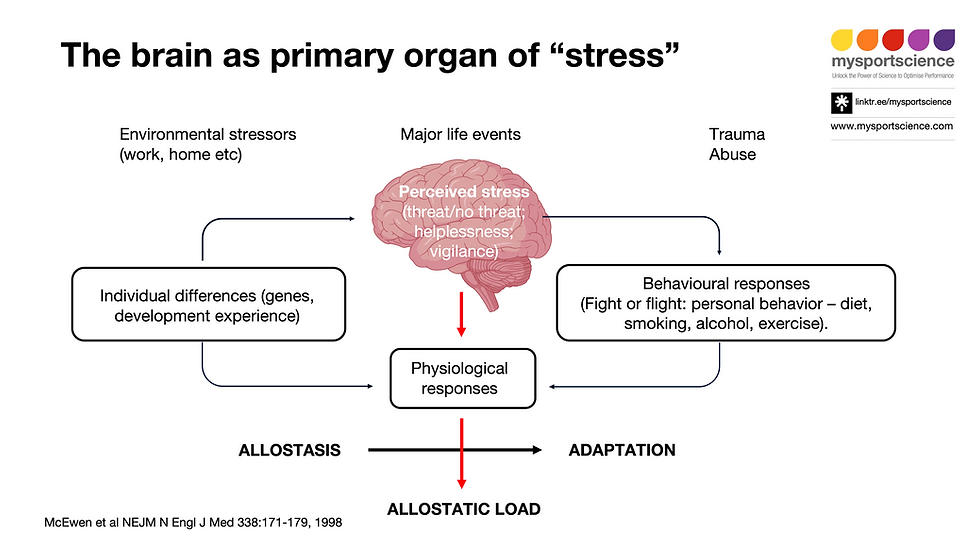
For example, the same training session can be perceived as manageable, meaningful, and motivating… or as threatening, chaotic, pointless, and draining. A 10 km run is a pleasant routine for one person and a genuine threat response for another.
Perceived stress states, such as threat, helplessness, and vigilance, drive downstream physiology. Prior experience, trauma, environment, genetics, and personal traits all modulate the appraisal. So allostatic load is not simply “training load”. It is the summed physiological cost of the athlete’s total perceived demands.
Load, stress, and strain: an engineering analogy
Sport science often uses the work "load" loosely. Engineering on the other hand is clearer:
Load: the external weights placed on the system
Stress: the internal reaction forces
Strain: the deformation that results
Picture a plank bending under weights. Training volume and intensity are weights. But so are contracts, media, sponsors, travel, body mass pressure, family conflict, financial stress, and social media. The plank bends not because one weight exists, but because the total load exceeds what the system can comfortably tolerate. Or because the system can’t recover its shape between hits.
And here’s the key nuance: resilience and perceived stress change the effective load. Two athletes can carry the same “load” on paper and experience very different internal stress and strain.
Stop chasing a single diagnosis
In sport we often use labels, such as overtraining syndrome, REDs/low energy availability, burnout, “mental health,” “under-recovery.” Labels can be useful, but they can also narrow thinking too early, especially when symptoms are nonspecific and overlapping.
An allostasis-based approach encourages a more useful question: "What is an athlete's total stressor landscape, and how is the brain appraising it?".

A pragmatic way to structure this is to map stressors across broad categories:
training/exercise load and recovery
life and environmental stressors
mental health factors
disordered eating/eating disorder risk
nutrition (energy/carbohydrate adequacy, micronutrients, alcohol)
sleep, jet lag, travel
illness/infection (including lingering viral issues)
underlying medical conditions (e.g., thyroid, etc.)
plus modifiers: genetics, development, experience, traits like perfectionism, high expectations, competitive drive, resilience
This doesn’t replace physiology. It organises it and stops you from making “single-cause” claims about complex presentations. There are many applications, not just in elite sport: including military training (5) and population health and chronic disease.
What does this change in day-to-day practise?
If you only take one practical message, take this: Remove tunnel vision and think of all possible stressors and how they are perceived. Tackle all stressors, not just one of them, even when you think this may the most important one.
Remove tunnel vision and think of all the possible stressors and how they are perceived.
A few principles follow naturally:
Stop treating training load as the whole load. Ask what else is heavy right now.
Watch for delayed shutdown. “Tired but wired” is not a personality quirk; it’s a sign the system is struggling to switch off.
Treat recovery as an active skill, not passive time. Sleep quality, downregulation routines, travel strategies, and psychological safety matter because they influence whether allostatic responses terminate efficiently.
Be careful with simple narratives. Low energy availability might be present, but measuring it is hard and the symptoms overlap with many other stress-load states. Likewise “overtraining” is often used when we don’t yet understand the full picture.
Work on appraisal, not just exposure. Two athletes can do the same session. The one who experiences it as purposeful and controllable will often pay a lower physiological price than the one who experiences it as threat and chaos.
Allostasis gives you a language for what practitioners have known for years: athletes break down not only from hard training, but from hard lives, especially when the system never fully resets.

One could follow a checklist like the Athlete Health and Readiness Checklist (AHARC). This is a checklist the refers to existing validated tools to assess allostatic load from various stressor categories. For each category a practitioner can choose the tools they think are most appropriate and the choice of tools depends on the context (for example if budget is limited the choices may be different from an environment with a lot of resources, or training load is assessed differently in different sports). In the next blog by Prof Michael Gleeson the use of biomarkers will be discussed in more detail.
The bottom line
Allostasis is not a buzzword. It’s a practical lens. Allostasis reminds us that elite performance depends on a system that can repeatedly mobilise resources and shut the response down. It explains why chronic stress can shift “normal” physiology into a costly state. And it provides a framework to assess the athlete as a whole rather than chasing single explanations for complex, overlapping symptoms.
So next time an athlete says, “Training hasn’t changed, but everything feels harder,” take it seriously. That sentence is often the first sign that the adaptive system is paying a growing bill. And in elite sport, the bill always comes due, unless we learn to read the early signals and manage the total load, not just the training one.
References
Stirling, P. Principles of allostasis in Allostasis homeostasis and cost of adaptation J Schulkin Cambridge University Press 2004
McEwen BS. Physiology and neurobiology of stress and adaptation: central role of the brain. Physiol Rev. 2007 Jul;87(3):873-904.
McEwen BS. Protective and damaging effects of stress mediators: central role of the brain. Dialogues Clin Neurosci. 2006;8(4):367-81.
Schulkin J, Sterling P. Allostasis: A Brain-Centered, Predictive Mode of Physiological Regulation. Trends Neurosci. 2019 Oct;42(10):740-752. This reference is not open access.
Feigel ED, Koltun KJ, Lovalekar M, Friedl KE, Martin BJ, Nindl BC. Advancing the allostatic load model in military training research: from theory to application. Front Physiol. 2025 Sep 26;16:1638451.
Jeukendrup AE, Areta JL, Van Genechten L, Langan-Evans C, Pedlar CR, Rodas G, Sale C, Walsh NP. Does Relative Energy Deficiency in Sport (REDs) Syndrome Exist? Sports Med. 2024 Nov;54(11):2793-2816.


