


Fish oil and omega-3 fatty acids: what are they and what are good omega-3 sources?
Feb 5, 2022
5 min read
Updated: 3 hours ago
Fish oil is one of the most widely used supplements, by athletes and by the general population. It is taken for many reasons, including heart health, joint health, recovery from training and brain function. Omega-3 fatty acids are the reason fish oil attracts so much attention.
In this blog we will answer four basic questions. What are omega-3 fatty acids? Why can the body not make all it needs? Which foods and supplements provide alpha-linolenic acid (ALA), eicosapentaenoic acid (EPA) and docosahexaenoic acid (DHA)? And what makes these fatty acids different from the other fats we eat? Whether fish oil improves health, performance or recovery is discussed in other blogs on this site, including does fish oil build muscle? and fish oil and injury.

What are omega-3 fatty acids?
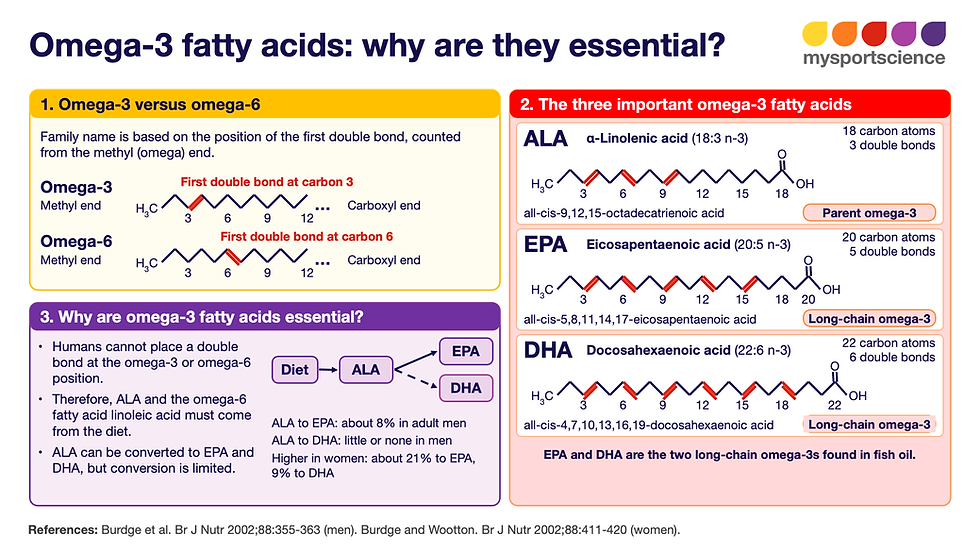
A fatty acid is a chain of carbon atoms. In an unsaturated fatty acid some of the carbon atoms are linked by double bonds, and the position of the first double bond, counted from the methyl (omega) end of the chain, gives the family its name. In omega-3 fatty acids it is at the third carbon atom, and in omega-6 fatty acids at the sixth.
Three omega-3 fatty acids are important in human nutrition. ALA has 18 carbon atoms and three double bonds. EPA has 20 carbon atoms and five double bonds, and DHA has 22 carbon atoms and six double bonds. EPA and DHA are the long-chain omega-3 fatty acids, and these are the two found in fish oil.
Why can the body not make them?
Humans lack the enzymes needed to place a double bond at the omega-3 or omega-6 position, so we cannot make ALA, or the omega-6 fatty acid linoleic acid, from other fats or from carbohydrate. Both have to come from the diet, which is why they are called essential fatty acids. ALA can be lengthened into EPA and DHA by a series of enzymes, but this conversion is limited. In adult men about 8% of ALA is converted to EPA and less than 0.1% to DHA (1). Conversion to DHA appears to be higher in women, possibly because of an effect of oestrogen (1, 2).
The body cannot make the parent omega-3 fatty acid, and converts only part of it into EPA and DHA.
How much this matters is still debated, because people who eat no fish maintain EPA and DHA in the body through conversion alone, and it has been argued that this is sufficient (3). What is clear is that intakes of EPA and DHA are low in most developed countries, at 0.1 to 0.5 g per day, because few people eat oily fish regularly (1).
What are good omega-3 sources?
Sources of ALA
ALA is made by plants. Good omega-3 sources (ALA) are flaxseed (linseed), chia seeds, hemp seeds and walnuts, and oils such as rapeseed (canola) and soybean oil. Green leafy vegetables contain smaller amounts (1). Because conversion is limited, these foods raise EPA and DHA in the body much less than EPA and DHA eaten directly.
Sources of EPA and DHA
EPA and DHA are made originally by microalgae, including diatoms and dinoflagellates, at the base of the aquatic food chain (4). Small marine animals eat the algae, fish eat those animals, and the fatty acids accumulate in the fish. This is why oily fish such as salmon, mackerel, herring, sardines and trout are the richest dietary omega-3 sources, with smaller amounts in shellfish such as mussels and oysters. The amount in a fish depends on the species and on what it has eaten.
The same fatty acids can be obtained from supplements. Fish oil is extracted from oily fish, and cod liver oil from the liver of cod. Krill oil comes from small marine crustaceans, and algal oil is made from cultivated microalgae and is suitable for vegetarians and vegans. The amount of EPA and DHA differs considerably between products. A capsule containing 1000 mg of fish oil commonly provides only about 300 mg of EPA and DHA combined, and the ratio of EPA to DHA varies. The relevant number is therefore the EPA and DHA content per serving on the label, not the weight of the oil.
The label is not always reliable. In a survey of commercial fish oil capsules sold in China, the EPA content met the labelled amount in 64% of products and the DHA content in 48% (5). These data come from one market, but the declared content cannot be taken for granted. Oxidation is a second practical issue. The double bonds in omega-3 fatty acids react with oxygen, and oil exposed to air, light or heat becomes rancid. Capsules should be stored sealed, in the dark and cool, and capsules that smell or taste rancid should be discarded.
Why are they special?
Most dietary fats are used as fuel or stored in fat tissue. EPA and DHA are also built into the phospholipids of cell membranes, where they influence how the membrane functions. DHA is particularly abundant in the brain and retina, where it accounts for about 40% of the fatty acids in the membrane phospholipids of the brain (6). When the intake of EPA and DHA increases, their content in blood and cell membranes increases over a period of weeks.
EPA and DHA are not only a fuel or a stored fat: they become part of the cell membrane.
Membrane fatty acids are also the starting material for short-lived signalling molecules that regulate blood clotting, blood vessel tone and inflammation. Omega-6 and omega-3 fatty acids compete for the same enzymes and give rise to different signalling molecules. This competition is the reason why the ratio of omega-6 to omega-3 in the diet receives attention. Human beings are thought to have evolved on a diet with a ratio of about 1:1, compared with 10:1 to 20-25:1 in Western diets (6).
Summary
ALA comes from plants, while EPA and DHA originate in marine microalgae and reach us through oily fish, shellfish and supplements made from fish, krill or algae. Conversion of ALA to EPA and DHA is limited, and intakes of EPA and DHA are low in most developed countries. Their roles in cell membranes and in inflammatory signalling explain the interest in them. Whether this leads to benefits for health, performance or recovery is discussed in other MSS blogs on fish oil, such as do athletes need fish oil supplements?. How omega-3 status is measured, and what the result tells an endurance athlete, is covered in the omega-3 index: what does it tell an endurance athlete?.
References
Williams CM, Burdge G. Long-chain n-3 PUFA: plant v. marine sources. Proc Nutr Soc 65(1) 42-50, 2006. doi:10.1079/pns2005473
Burdge GC. Metabolism of alpha-linolenic acid in humans. Prostaglandins Leukot Essent Fatty Acids 75(3) 161-168, 2006. doi:10.1016/j.plefa.2006.05.013
Burdge GC. α-linolenic acid interconversion is sufficient as a source of longer chain ω-3 polyunsaturated fatty acids in humans: an opinion. Lipids 57(6) 267-287, 2022. doi:10.1002/lipd.12355
Peltomaa E, Hällfors H, Taipale SJ. Comparison of diatoms and dinoflagellates from different habitats as sources of PUFAs. Mar Drugs 17(4) 233, 2019. doi:10.3390/md17040233
Zhou Q, Xu L, Xu Y, Xue Q, Xue C, Jiang X, Wen Y. Systematically investigating the qualities of commercial encapsulated and industrial-grade bulk fish oils in the Chinese market. Foods 14(9) 1623, 2025. doi:10.3390/foods14091623
Simopoulos AP. Evolutionary aspects of diet: the omega-6/omega-3 ratio and the brain. Mol Neurobiol 44(2) 203-215, 2011. doi:10.1007/s12035-010-8162-0
Burdge GC, Calder PC. Conversion of alpha-linolenic acid to longer-chain polyunsaturated fatty acids in human adults. Reprod Nutr Dev 45(5) 581-597, 2005. doi:10.1051/rnd:2005047


